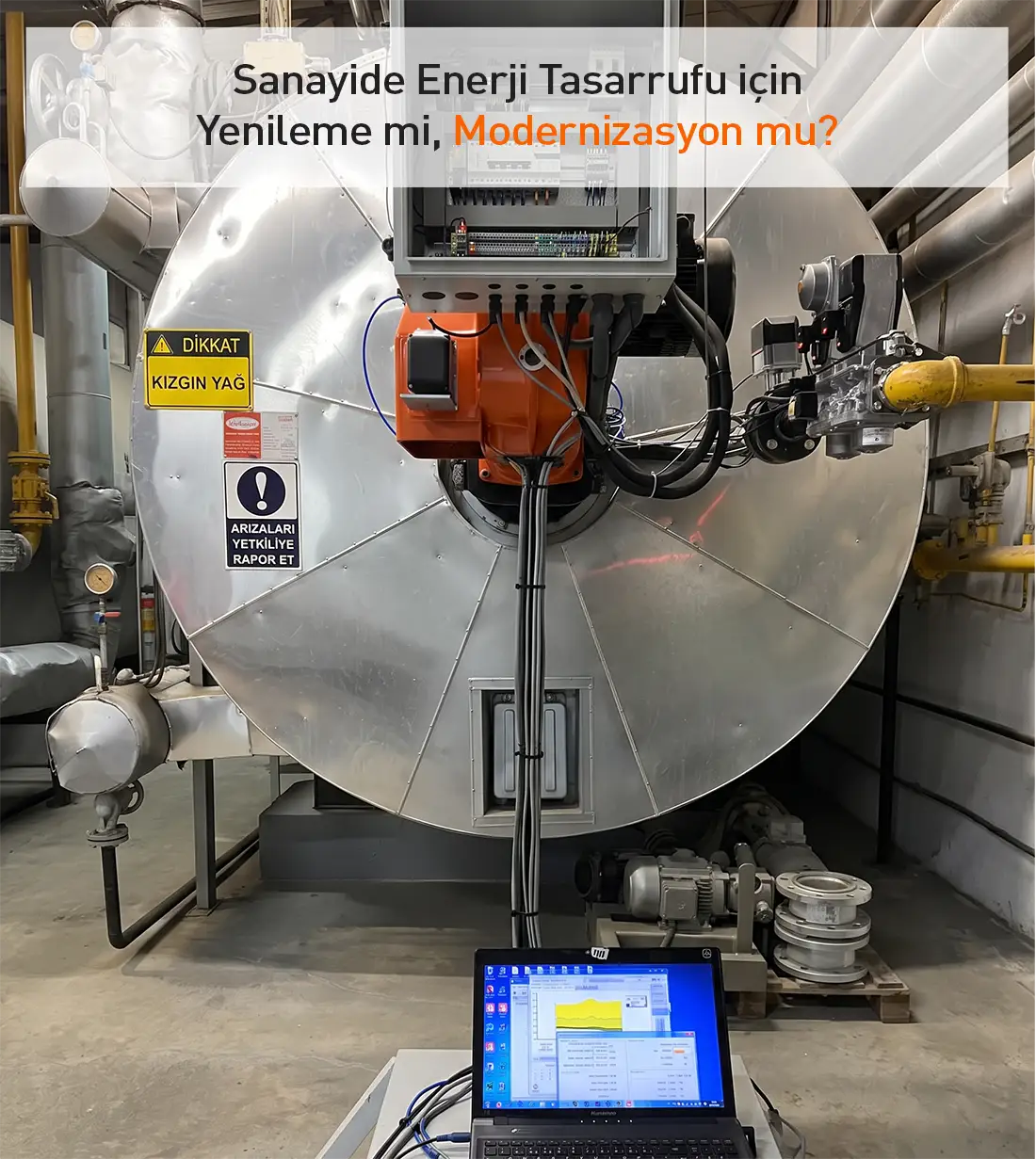
Approximately 50 percent of the natural gas and oil imported into our country is burned by burners. About half of the consumed fuel is used in the manufacturing industry, while the other half is used in buildings for heating purposes. This picture highlights the importance of burners in terms of fuel consumption and energy efficiency, especially in energy-intensive industrial plants. At this stage, businesses seeking to reduce energy consumption caused by existing burners are faced with two distinct options: replacement and modernization.
H. Ahmet İlhan, Chairman of the Board of Gökçe Burner, states that in systems that have reached the end of their economic life or experienced a decline in performance, the question of "replacement or modernization?" should be answered by evaluating the operating conditions, maintenance history, fuel consumption, and emission values of the facility together.
Industrial burners, which are among the fundamental elements of process heat in manufacturing, power generation, and infrastructure facilities, directly impact fuel consumption and emissions. Particularly in systems used for many years, mechanical wear over time, technologically outdated control systems, inability to precisely control the air-fuel ratio, and adaptation issues to changing process conditions can increase energy losses.
"A boiler operates only as well as the performance of its burner"
In a report published by the U.S. Department of Energy's Office of Energy Efficiency and Renewable Energy (EERE), it is stated that "A boiler operates only as well as the performance of its burner. A poorly designed boiler with an efficient burner can perform better than a well-designed boiler with a poor burner." This evaluation reveals that the burner is not merely equipment that ignites fuel, but plays a crucial role in the overall performance of the boiler system.
The impact of burner performance on system efficiency becomes even more prominent, especially in energy-intensive industrial manufacturing facilities. The performance of burners used in these facilities directly impacts operating costs in addition to fuel consumption, combustion efficiency, and emissions. The technical condition and operating performance of the existing burner serve as decisive factors in determining whether replacement or modernization options should be evaluated for fuel savings.
Stating that burners, as key elements of process heat in manufacturing, power generation, and infrastructure facilities, can undergo mechanical and technological degradation over time, H. Ahmet İlhan, Chairman of the Board of Gökçe Burner, notes that not every old burner needs to be replaced and that the performance of the existing system should first be evaluated.
"The modernization option should be evaluated first"
Highlighting that modernization is an important option in facilities where the mechanical structure of the existing burner remains usable but control systems lag behind current technologies, İlhan made the following assessment:
"The advancing age of a burner is not a condition that alone warrants replacement. First, one must examine the existing system's fuel consumption, combustion values, emissions, and control infrastructure. In a mechanically usable burner, performance can be improved by renewing the control system, managing the air-fuel ratio more precisely, readjusting combustion parameters, or integrating technologies such as O₂ trim into the system. Therefore, modernization opportunities should be evaluated before deciding on replacement."
If modernization is insufficient, replacement comes onto the agenda
Expressing that full replacement should come onto the agenda in cases where the existing burner is mechanically worn, its capacity and operating range fail to meet facility needs, or it struggles to comply with current emission and safety requirements, İlhan continued as follows:
"If the burner has completed its mechanical lifespan, spare parts and maintenance options are limited, combustion performance cannot be stably controlled, or the existing equipment fails to meet process needs, modernization may not be sufficient. In such a scenario, switching to a new-generation burner becomes a more accurate investment both technically and in terms of long-term operating costs."
"Fuel savings of up to 15 percent can be achieved"
Stating that the advantage of new-generation burners in fuel consumption stems not only from the equipment being new, but from the ability to control the combustion process more precisely, H. Ahmet İlhan said, "It is not accurate to express the savings provided by a new-generation burner with a single rate. The operating efficiency, capacity, operating duration, and fuel type of the existing burner directly affect the result. However, under the right conditions, replacing an old burner with a high-efficiency modern system can provide fuel savings of up to 15%."


 TR
 RU


Our expert mechanical engineers will get back to you regarding our most suitable and efficient combustion systems for your projects.